FOREVER FRIENDS ON FOREVER HOWLONG

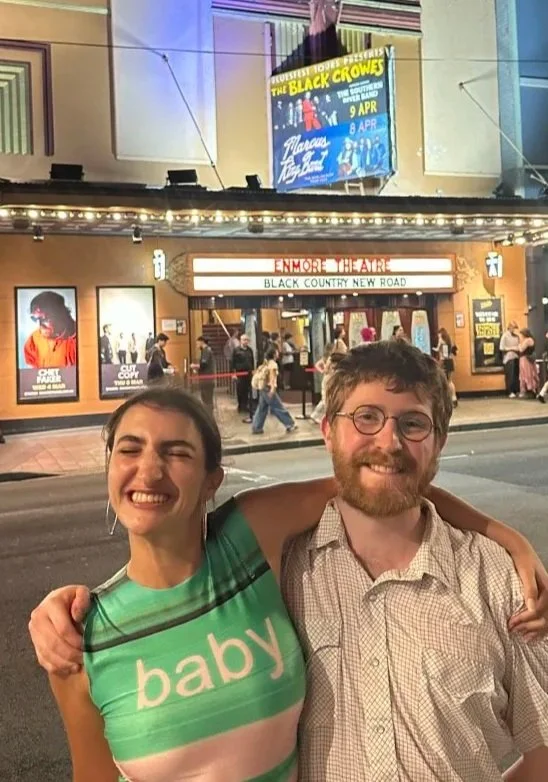
Captured by: Eddie Whelan
In Conversation with Black Country, New Road on their latest studio album
The crowd falls silent as a purplish glow envelops the stage. It’s 2018 at the Windmill Brixton in London, and for the first time, I’m watching some friends perform. A lone saxophone bleats a Klezmer-like cry, and soon the whole 7-piece band swells with intense unsettling arrangements that rise—each instrument clambering over the others in organised chaos, and fall—into quiet, introspective passages, punctuated with Isaac Wood’s angsty talk-sung-shout lyrics.
I was transfixed. It captured the frenetic energy of London I so much revered, the kind of music that held you in tight grip. I saw them play across the city in small sweaty rooms, sometimes packed, sometimes not; swept too into their green rooms and living rooms, amongst the loud and quiet moments, the witty remarks and couch dinners, the blooming friendships of 20-something-year-olds finding their way. I left London with a handful of memorable performances, shoddy live phone recordings and the hunch that what I’d seen wasn’t the end.
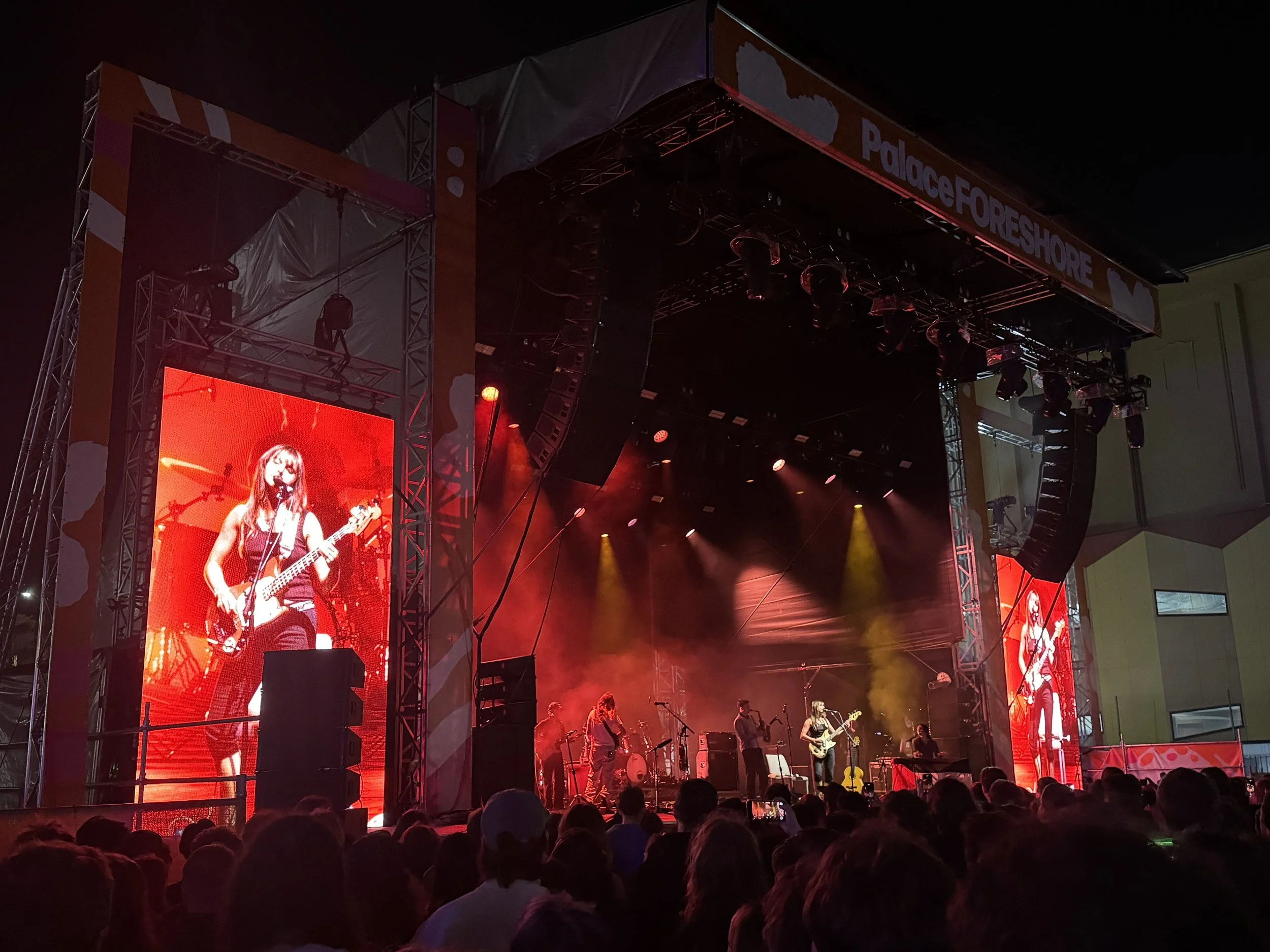
6 years later, Black Country, New Road made their Australian debut, sans Isaac, in my hometown at the Sydney Opera House, playing music like I’d never heard them play before. Many of those live performances would soon grow into their latest studio album, Forever Howlong—an album that I haven’t stopped listening to.
Critics and Reddit-dwelling fiends have remarked how different it sounds from anything BCNR has done. Violinist Georgia Ellery, bassist Tyler Hyde and keyboardist May Kershaw have taken on the songwriting and singing, an evolution that’s brought a folk-inspired levity to their sound.
It’s beautifully buoyant with a dark undercurrent, unravelling into a world of luscious melodies and ethereal storytelling—traversing the pains of a young girl getting teased in ‘Mary’, the medieval-esque horseback journey ending with brutal murder in ‘Two Horses’, unrequited queer longing nestled quietly beneath female friendships in ‘Besties’. It’s an album with the same BCNR rises and falls; this time with elegant restraint.
Like any band or group of friends, they’ve grown, and this growth rings clear on Forever Howlong. Amongst their album tour this Australian summer, I spoke with drummer Charlie Wayne and keyboardist/vocalist May Kershaw about BCNR’s remarkable evolution—and why, through it all, their friendship remains forever constant.
Answers have been edited for clarity.
Charlie Wayne: It’s nice to see you Chloe, how are you?
Chloe Hayman: I’m so excited to see you both back in Australia, it’s been a minute. I went overboard with my questions so I’m going to have to reel them back, because as soon as the album came out, I’ve been playing it non-stop. It comes with me on every walk, every drive, every conversation. Thank you for making the album; I feel like it’s going to journey with me through a lot of different memories to come.
May Kershaw: That’s so nice to hear.
Chloe: I want to start with the obvious; this album sounds different to the others. It feels more ethereal and restrained compared to your past louder dissonance, but it still feels distinctly like Black Country, New Road. What were the biggest throughlines from your previous albums when you were making it?
May: I think our arrangement style is the same path we’re all on together, and right now we’re just a bit farther along our arrangement journey as a band. I feel like that’s probably what gives us our sound—someone comes in with the base structure of the song, and then how it’s built up together is a similar process to previous albums.
Charlie: Yeah, I think so. I think in terms of arranging and songwriting, we tried to be more restrained in our approach, even though instrumentally it’s much more maximal than anything going on before. It’s not just 6 people playing in a room together, which definitely was the M.O. for the first and second album to some extent. There was definitely a conscious decision to make music that’s really interesting, rather than, you know, ahhhhh the whole time because I think we’ve done that quite extensively. That has diminishing returns; it doesn’t feel as interesting after you’ve done it for a long time.

Chloe: It sounds like you’ve added that constraint to make it more of a challenge… like the brief to yourselves was to start smaller, and as a result, you’ve put even more complexity into it.
May: I feel it was a bit the other way around…we spend a lot of time trying lots of different arrangements or structures, and then work out whether each thing we’re suggesting is actually necessary.
Charlie: Yeah May’s totally right. We did more stuff; we didn’t limit ourselves at all, particularly in the studio. On some of the songs like Big Spin, we added a whole other third section from
an old song, but it just didn’t make any sense after really, really trying. Same goes for Forever Howlong, the title track. We added loads more stuff but then we had to take it away because it felt like too much. Which is a good thing; it’s good to know when you’ve reached a saturation point.
Chloe: It also takes a lot of confidence to pare things back.
Charlie: It’s one of those things that feels natural, but I think you’ve also got 6 different people that all feel like they’re controlling what happens. t’s not like cooking; you can always take ingredients away once you’ve added them.
Chloe: Well, that’s a good segue because I’m always interested in how you manage to balance everybody’s individual voice in such a big group, because like any good art, I think you each need a piece of yourselves inside. May, Georgia and Tyler took care of singing and the bulk of songwriting, but all 6 of you still needed to leave your mark in the storytelling. How did you capture everyone’s individual expressions within such a cohesive body of work?
May: We all have quite strong opinions, so I think the arrangement process becomes so interrogated. Often it’ll be the majority vote in terms of one little bit of a song we’re trying to figure out, or whether it feels like it’s staying true to the initial person who brought in the song, which will have a bigger weight to the vote. But I feel like we all win some and lose some, and that’s how it goes.
Chloe: That’s life.
Charlie: [laughs] Yeah, I think you gain stuff and you have to concede stuff, and that’s always been the way it’s gone. With the previous albums, Isaac brought the majority of those basic song structures, so we got into a rhythm with how that creatively disseminated between us. [With this album] you’re working with 3 people with 3 different kinds of ideas, so you have to judge in different ways where to fit in your individual voice.
I think Lewis on this album was really good at just being like, look, I’m having to serve this song as a kind of an ensemble player. Which is funny because lots of his parts actually do stick out in really personable ways. He was trying to blend in more than stand out which is a really good ethos to have; that’s generally the direction everyone was trying to take—to define themselves by how it sits together rather than sticking out.
Chloe: On top of 6 different voices, some of the songs started or were performed years ago by different band members with different lyrics, track titles and arrangements. Like Salem Sisters, originally written and performed by Lewis [Evans] until he stepped back from singing and gave the song to Tyler [Hyde] to rework. You’ve always tinkered with your songs, way back even on your debut record, For the first time, where lyrics and certain arrangements changed from previous recordings and performances. With so much tinkering from different people, how do you know when a song finally feels like a finished BCNR track?
May: I think playing live is quite important for getting it on its way to feeling more complete; our strengths are in playing live and working out whether songs work as a performance, so we played all of this album live before recording which made them feel like Black Country songs. I felt like there was a further step this time of considering how we could keep their essence on a studio album—all our other albums we’ve basically recorded all of us playing live at the same time with a few overdubs. This time, there were a few songs where we did that, but others where we recorded things separately, it was more layer by layer.
Charlie: I think there’s a step slightly before where you play it to the group for the first time, and we talk about whether it makes sense as a BCNR song for right now. I remember Tyler playing Happy Birthday and May playing a bit of what became the Big Spin, and it didn’t necessarily feel like they made sense. But both those things immediately began sparking little ideas of what the song could look like as an arrangement with the 6 of us playing together.
Chloe: Totally, once you’ve got the feeling of what shape it could take, everything starts to become in service of that. I noticed that while this album sounds a bit more light and colourful, almost every song carries an undercurrent of grief, violence or longing. Why do you think so many dark lyrical themes entered the music, and how did you balance light and shade without one overpowering the other?
May: Yeah, good question. I feel like the themes are in my life so that’s why they come out, and then getting the right balance is super important. Because you can be, you know, lonely, and it not necessarily be such a bad thing. It’s never just one or the other [good or bad], which I don’t think anything ever really is, so it can be up to how you’re feeling when you’re listening to it.
Chloe: What about specifically on the drums, Charlie—you’ve had to use even more restraint than you have on previous albums, was that challenging?
Charlie: Yeah, I think drum-wise this album has been the most interrogating I’ve had to do about what the role of the instrument is. When we were writing the songs, some of them didn’t really make sense with any drum parts, and it became the case of realising that either the drums had to sound totally different and be almost like percussion parts, or the parts had to really adjust themselves around the songs.
In that way, I think of the album in two parts—some of the songs like Besties and Happy Birthday are really groovy, and you have to tell yourself it’s ok to just play simple, groovy drum parts. And then the other half is about playing quite strange percussive bits that are really exciting to think about and write. Like on Socks, everyone had to adjust their playing around how Tyler performs it on the piano in lots of different mini sections, which is great, because it makes for a very active arranging and writing process; you can’t just get away with doing something that feels straightforward.
Chloe: You’ve got to substitute loud with clever.
Charlie: Yeah, I think so. It was quite hard, but a really good challenge. It’s also where the studio was really important, knowing that you can actually have a space for the drums and all the instruments to sit in different sonic environments. The studio can be just as much of an expressive part of the music as the performance, which is cool.
Chloe: It is cool. Switching gears now, in the last couple of years, you’ve been touring on almost every continent. Has being far away from home changed your writing? And have any of the new places you’ve visited crept into your imagination in surprising ways?
May: It definitely affects my head, I’m in a bit of a dream state when I’m on tour where I can’t think too much into the future or the past, just focusing on the next 4 hours ahead. I actually wrote some of the lyrics while on tour, and they’re so specific to that time and place. Being in tour fog brain gives such a different way of writing, whereas writing Forever Howlong (the song) was very much I’m back at home and in my routine. But yeah, it’s a strange way to live your life and feel time.
Chloe: Totally. What about you Charlie?
Charlie: It’s very strange. In 2024, when we came to Australia and saw you last time, that was right at the back-end of basically an 18-month tour without any real time off, which was crazy. Then we went straight into writing and recording. And before coming back on tour, we were at home for months.
Obviously it’s a massive privilege to have this as our work, but I find it quite a big readjustment coming home, when you’re not writing or touring, and where everything relies so heavily on being self-directed. May’s right, on tour you’re in a dreamlike state, floating from venue to venue, city to city. Everything always starts in the afternoon, you play at night, and then start the day again. The routine is extremely erratic, but I kind of missed it. It makes for a strange relationship with work and downtime. Even stranger now that we’ve been back on tour for a while.
Chloe: It’s a different sense of momentum in how you spend your time. I want to know what you’ve been watching, reading or listening to that’s stuck with you lately. And how much of this do you share with the group?
May: I went to see Blue Velvet in the cinema, it’s weird and intense but I liked it. Me and the girls were watching Severance on the last tour, one night we were cutting it pretty fine, it was like 30 minutes until stage time [laughs]. Me and Charlie keep up to date with what each other are reading too; I’m reading Brideshead Revisited at the moment, I’m not sure if Charlie will like it but I think it’s worth a Charlie read.
Charlie: We’ve spoken a lot about Evelyn Waugh, particularly A Handful of Dust and had mixed opinions about it.
May: Didn’t love it. But I think this one is worth it, even if you don’t like it.
Chloe: What about you Charlie?
Charlie: I finished the new season of White Lotus, which you know…it was what it was. I’ve been keeping up with the arguments that Mike White’s been having with the composer, it seems like a real mess. Lewis [from BCNR] has a radio show with our friend Jack, so I’ve been listening to that. He’s travelling at the moment, so our conversations online are just sending albums to one another which has been nice. I read Actual Air, David Berman’s, from the Silver Jews, poetry collection, which was very very good. He’s one of my favourite lyricists of all time, and his poetry collection is amazing. I keep on revisiting their music and Purple Mountains, the album. It never stops being brilliant for me; the music is so simple, but I find it so rewarding and moving.
Chloe: Ok last question. I have so many, but I’ll choose one. Since we were together in London and you were just starting out—so much life has happened. You’ve had big changes to the band, lived and toured all over the world together, grown in clout and critical success, and grown in your own selves too. What’s changed about your friendships with each other?
May: I think not much, we’re all just already friends which makes it so much easier, but also maybe it’s nice having so many of us; it’d be more intense if there was less. We’ve got lots of little different combinations of groups, like different societies [laughs]. There’s a running group, which is Lewis and our two sound men. And now Charlie’s joined it too.
Chloe: Charlie’s joined the running SOC!
Charlie: [laughs] I think May’s right, the only thing that’s really changed is that we’ve all got new hobbies. We still see each other regularly in the exact same way we’ve always done—like the friendship group remains floating around the band. It’s a very, very nice constant and I hope it continues to remain.
Chloe: It sounds like you’ve got such a strong foundation, that wherever you go next, in all the reinvention that continues to happen for BCNR, you’ve all always got each other.